How to choose a bid goal for new products
Use unit economics and early evidence to choose a pilot target.
Start from the unit, not the account average
A new accessory sells for $48 and costs $25 to ship, fulfill, and process. If you want $8 left after acquisition, $15 is available for the first order. A $30 target inherited from the main product would use more than the accessory can support.
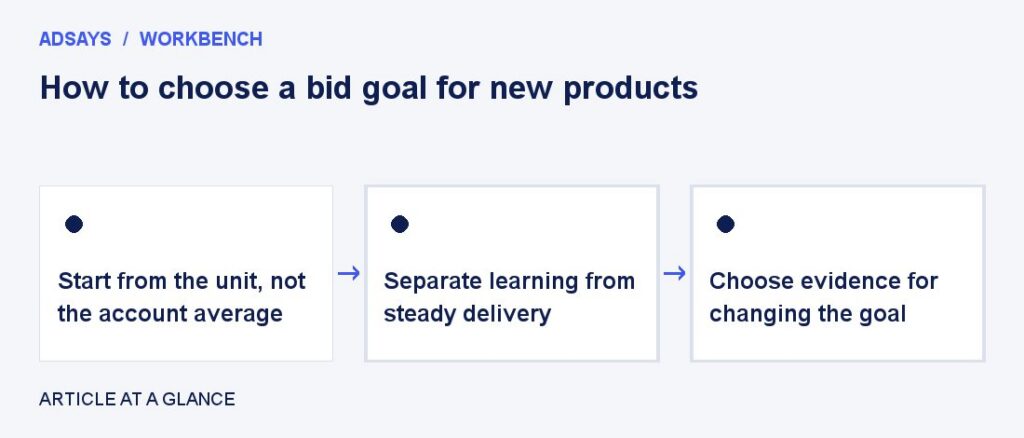
Separate learning from steady delivery
Give the new product a defined pilot budget and record which orders include it as a first purchase or as an add-on. Use the same contribution rule for both periods. A small budget can establish that tracking and demand exist before it estimates reliable CPA.
Choose evidence for changing the goal
Update the target if net price, fulfillment cost, or realized product mix changes. If only volume changes, first inspect whether impressions, clicks, or landing-page conversion are the bottleneck. Raising the bid goal is useful only if acquiring the additional order is still worth the cost.
Try a related tool
Estimate what you can pay to acquire an order while reserving a desired contribution. Use consistent per-order inputs.