How to set a target CPA from contribution margin
Set an acquisition ceiling that leaves room for the profit you need.
The scenario
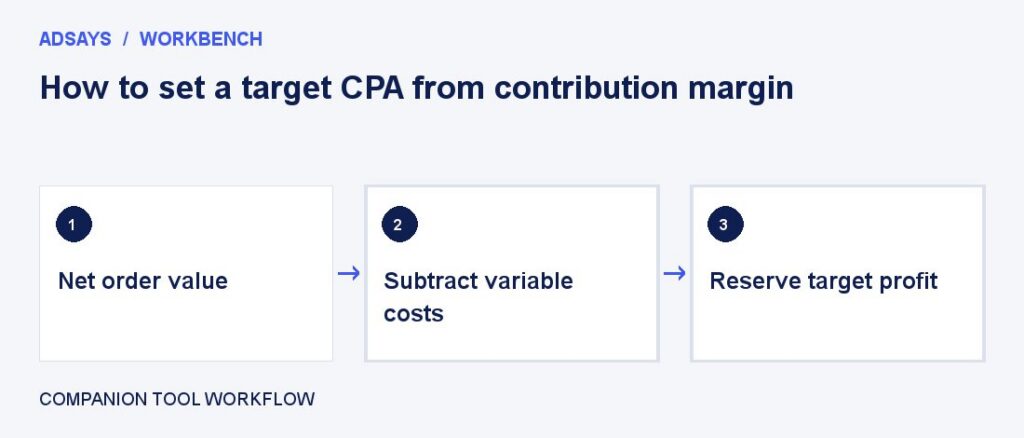
A $95 order has $37 in variable costs and you want $18 left after acquisition.
The maximum CPA is $40: $95 minus $37 minus $18. At $47 CPA, you still earn contribution, but miss the target by $7.
Apply it to your own work
Write down the costs that scale with an order and decide how much contribution must remain. Give the buying team that ceiling and recalculate after a promotion changes the net selling price.
Turn a sales goal into a lead target
If 25% of qualified leads become orders and your order CPA ceiling is $40, your media cost ceiling is $10 per qualified lead before additional sales handling costs. If the close rate drops to 15%, the same model supports only $6 per lead.
Use a mature lead cohort from your CRM and keep the close rate beside the target. A paid channel that meets the lead ceiling but misses the sales ceiling needs a quality check before you increase spend.
What to watch for
A CPA ceiling based on first-order contribution is different from a ceiling based on repeat purchases. Keep the two scenarios labeled.
Translate the order ceiling into channel targets
If first orders leave $40 for acquisition and 20% of qualified leads close, a $45 cost per lead will not work under that model. The implied acquisition cost is $225 per sale before sales handling costs. A channel that closes at 40% can support twice the lead cost of one that closes at 20%.
Calculate close rates by channel from mature cohorts. If you include a sales commission as a variable cost, subtract it at the correct stage and document it. Review the ceiling whenever product mix shifts or a campaign starts attracting lower-value orders.
Try a related tool
Estimate what you can pay to acquire an order while reserving a desired contribution. Use consistent per-order inputs.