Compare two affiliate offers with a scorecard
Weigh payout, conversion, terms, and reader fit together.
The scenario
Offer A pays $100 and converts 0.5% of clicks. Offer B pays $45 and converts 1.5%.
Before reversals, A earns $0.50 per click and B earns $0.675. Availability, return rates, support, and the reader's expected cost can still change the choice.
Apply it to your own work
Document pricing and terms with dates. Score reader fit first and forecast revenue separately. Use a reversible test with a defined sample before replacing every link.
Use a minimum fit gate
Start with three pass-or-fail criteria, such as country availability, self-service cancellation, and a required integration. Exclude offers that fail a criterion essential to the audience before comparing payouts.
For the shortlist, add current plan cost and a source beside each factual claim. Model reversals separately: a 30% reversal rate lowers Offer B’s expected EPC from about $0.68 to about $0.47, under the original assumptions.
What to watch for
A high payout does not compensate for a poor product fit. Keep factual product comparisons independent of the commission column.
Compare the choice the reader actually faces
Record total buyer cost, eligibility, renewal terms, and cancellation alongside the offer model. Mark any hard reader constraint as pass or fail before scoring commission. If one service does not support the required workflow, it does not belong on that shortlist.
Forecast accepted commissions separately. If B reverses 30% while A reverses 5%, their expected EPCs are about $0.47 and $0.475. Small model changes can erase the initial payout advantage, so document the assumptions.
Try a related tool
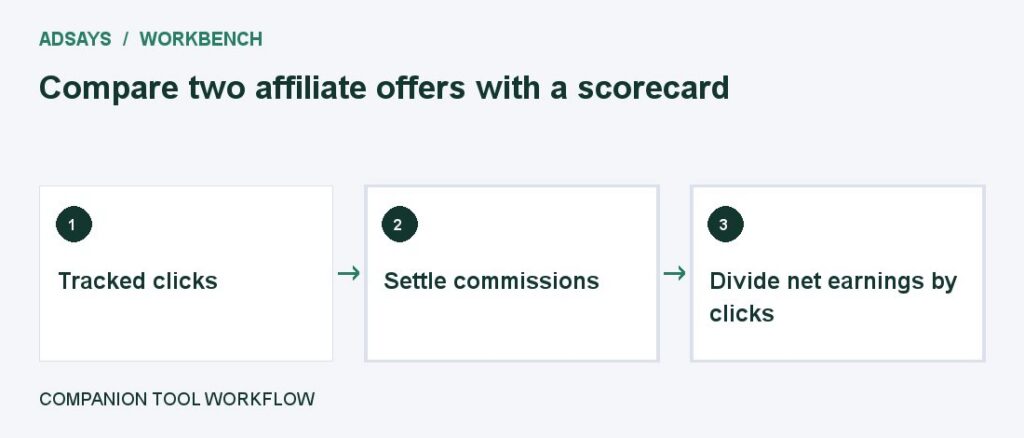
Measure earnings per tracked referral click after refunds and reversals. Use counts and commissions from the same cohort.